The Loop Is the Song: How Bedroom Producers Are Rewriting Music's Rules One Cycle at a Time
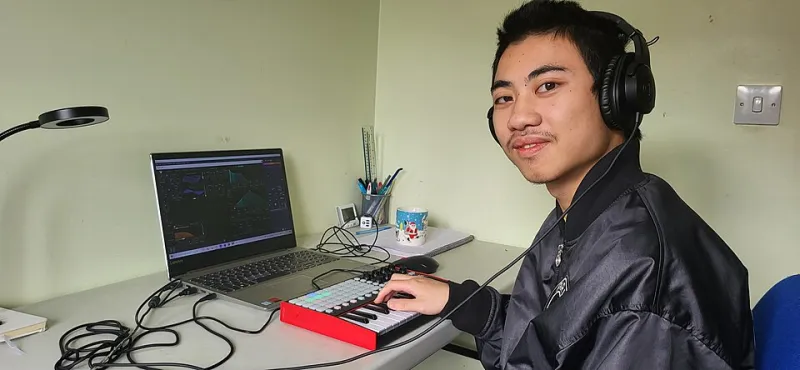
Photo: HowardXiong2026, CC BY 4.0, via Wikimedia Commons
There's No Drop Coming. That's the Point.
Somewhere in a Chicago apartment, a 19-year-old named Maris is stacking the same four-bar phrase for the eleventh time, nudging the filter cutoff a few degrees each pass, watching the waveform repeat in her DAW like a hypnotic spiral. She's been working on this track for three weeks. It is, by conventional music industry standards, not a song. There's no verse. No chorus. No bridge. No hook you could clip for a commercial.
She posted a 30-second preview on SoundCloud last Tuesday. It has 4,000 plays.
"People keep asking me when the drop is," she says, laughing. "There's no drop. It just keeps going and going and then it stops. That's the whole thing."
Maris — who produces under the name sftcrsh — is part of a loose, largely online movement of bedroom musicians who are pushing back against the structural conventions of mainstream pop production. Their weapon of choice is the loop: cyclical, repetitive, deliberately refusing to resolve in the way listeners have been trained to expect.
How We Got Here
To understand why the loop feels radical right now, it helps to understand what it's reacting against.
For the better part of the streaming era, the dominant production philosophy has been ruthlessly front-loaded. Skip-proof intros. Hooks in the first seven seconds. Verses designed to feel like pre-choruses. The architecture of the modern pop song was essentially engineered around the threat of the skip button, which created music that was technically efficient and emotionally exhausting — always building, always escalating, always demanding your full attention.
Gen Z grew up inside that architecture. They also grew up inside TikTok, where a 15-second loop could become culturally definitive without anyone needing to hear the full song. They grew up with lo-fi study beats — eight-hour YouTube streams of the same ambient loop cycling indefinitely — as background to their entire adolescence. They grew up with hyperpop's willingness to detonate song structure entirely, turning tracks into collages of competing intensities.
The result is a generation of producers who don't hear repetition as laziness. They hear it as a statement.
The Geometry of Sound
Producers working in this space talk about their music in distinctly visual, spatial terms. Loops aren't just repeated phrases — they're shapes. Circles. Spirals. Structures that move through time without necessarily going anywhere linear.
Jordan Tae, a 22-year-old producer from Atlanta who releases ambient-adjacent electronic music under the name Veldtform, describes his process as "drawing the same line over and over with a slightly different pen each time."
"Traditional song structure is like a road trip," he explains. "You leave home, you go somewhere, you come back changed. Loop-based stuff is more like... orbiting. You're always near the same center of gravity. But your perspective shifts because you keep moving around it."
This geometric thinking shows up in the production techniques themselves. Many of these artists work primarily in Ableton Live's session view rather than the arrangement view — a workflow that encourages thinking in modular, interchangeable blocks rather than linear timelines. Others use tools like Teenage Engineering's OP-1 or various Eurorack synthesizer setups that physically embody cyclical thinking through their sequencer designs.
The aesthetic overlap with visual art and meme culture is not accidental. The same logic that makes a perfectly looping GIF satisfying — the clean return to origin, the sense of perpetual present tense — is what these producers are chasing in audio form.
TikTok as Accidental Music Theory
It's impossible to talk about this movement without acknowledging TikTok's structural influence, even among artists who have complicated feelings about the platform.
The 15-second format didn't just create a new promotional tool for musicians — it created a new unit of musical meaning. A sound that works on TikTok works because it's immediately distinctive, endlessly repeatable, and self-contained. It doesn't need context. It doesn't need setup. It just needs to hit and keep hitting.
That's a loop. Functionally, algorithmically, culturally — TikTok trained an entire generation to find satisfaction in the cycle rather than the journey.
"I think about TikTok sounds when I'm producing, even when I'm not making anything for TikTok," admits Priya Menon, a 20-year-old producer and visual artist from the Bay Area who makes what she calls "furniture music for people with ADHD." "There's a certain quality a loop has to have where you don't notice when it restarts. That's the goal. If you can hear the seam, you failed."
Priya's tracks rarely exceed two minutes. Several are under 90 seconds. She considers this a creative constraint, not a limitation — the same way haiku poets don't consider syllable counts a burden.
Breaking Down the Production Approach
For producers curious about the methodology, the core principles are more accessible than they might seem.
The foundation is usually a short phrase — anywhere from one to eight bars — that contains enough internal variation to sustain interest across repetitions. The goal isn't mindless repetition; it's revealing new facets of the same idea over time, the way rotating a crystal in light changes what you see without changing the crystal.
Layering is everything. Most producers in this space work by building loops in parallel rather than in sequence — adding elements not to escalate tension but to add density, then removing them not to release tension but to create breathing room. The emotional arc comes from texture and timbre, not from structural climax.
Harmonic stasis is a common choice. Many of these tracks avoid chord progressions entirely, sitting on a single drone or a two-chord oscillation indefinitely. This isn't poverty of imagination — it's a deliberate decision to remove one of the primary engines of forward motion in Western music, forcing the listener to find satisfaction in other dimensions of the sound.
What This Actually Means Culturally
Loop-based music as a creative rebellion isn't really about music. It's about time.
Mainstream pop music, at its core, is about the future — the build, the drop, the resolution, the payoff. It's optimistic in a very specific, linear way: keep going and you'll get somewhere better.
Loop-based production is about the present. It says: this moment is enough. This texture, this feeling, this particular combination of frequencies — you don't need it to go anywhere. You can just be inside it.
For a generation that came of age during a pandemic, during climate anxiety, during the endless present-tense scroll of social media, that's not a minor aesthetic choice. It's a worldview.
"I don't want my music to feel like it's trying to get somewhere," Maris says, queuing up another version of the track she's been refining for three weeks. "I want it to feel like it's already there."
The loop plays. It ends. It starts again. Somewhere in that cycle, there's something that feels, against all conventional logic, like arrival.